










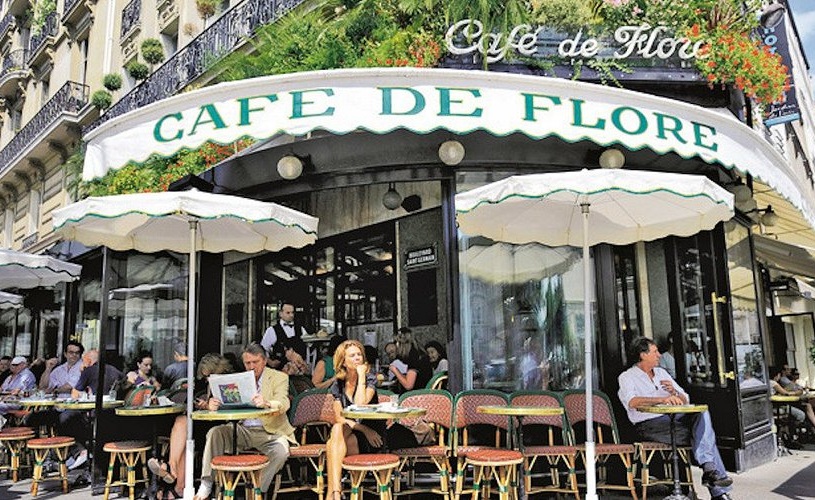
Café de Flore: The Warm Hearth of Existentialist Philosophy

Café de Flore: The Warm Hearth of Existentialist Philosophy

Tucked along Boulevard Saint-Germain, Café de Flore is far more than a celebrated Parisian coffeehouse. During the bleak, frozen winters of the German occupation in the 1940s, this historic establishment transformed into an intellectual fortress. Drawn by the rare luxury of a burning coal stove, literary titans Jean-Paul Sartre and Simone de Beauvoir made the cafe their daily living room, debating freedom, consciousness, and the core tenets of modern Existentialism across these very tables.

⏳ Era & Origin
Founded in 1887 on Boulevard Saint-Germain during the Third Republic.
📍 Location & Transit
172 Boulevard Saint-Germain, at the corner of Rue Saint-Benoit.
🕒 Suggested Time
30 to 45 minutes for a drink and reflection.
💡 Insider Tip
Notice the preserved Art Deco red leather seating and mirrored walls.
🎧 20-Second Audio Guide Preview

“Look past the red banquettes and polished mirrors to the quiet corner tables. Here in the 1940s, a simple coal stove kept Jean-Paul Sartre and Simone de Beauvoir warm through the frozen wartime occupation. Every morning they claimed these seats to write. What revolutionary thoughts were sparked beside that iron stove?”

🗺️ Exact Landmark GPS Location
48.85420, 2.33260
📍 Latin Quarter & Saint-Germain
Walking Directions

Historical Origin, Artist & Backstory

Established in 1887 during the French Third Republic, Café de Flore took its evocative name from a sculpture of Flora, the Roman goddess of flowers and spring, that originally stood across the boulevard. While the cafe attracted literary patrons from its inception, its most pivotal era arrived in the 1940s. Amid the harsh shortages and bitter cold of the World War II occupation, fuel for heating was exceedingly scarce across Paris. Café de Flore possessed a functioning coal stove that kept its interior remarkably warm. Jean-Paul Sartre and Simone de Beauvoir seized upon this haven, arriving early each morning to secure adjacent seats. They spent entire days reading, drafting manuscripts, and conferring with fellow writers such as Albert Camus. What began as a practical search for physical warmth evolved into an intellectual revolution, cementing the venue as the definitive birthplace of mid-century French Existentialism.

Visual Details, Technique & Hidden Symbolism

The interior of Café de Flore preserves the elegant Art Deco aesthetic crafted during its major renovation in the 1920s and 1930s. Deep red moleskin banquettes line the perimeter, paired with polished mahogany paneling and gleaming brass fixtures. Expansive wall mirrors reflect the warm, amber glow of classic chandeliers, creating an illusion of boundless space while enabling discreet people-watching, a tradition deeply woven into French cafe society. Outside, the distinctive green-and-white striped awning and cascading floral boxes honor the Roman deity of blossoming nature. The upstairs salon, known as the first floor, offered a quieter sanctuary where Sartre frequently drafted passages of Being and Nothingness away from the bustling ground level. Every element, from the porcelain Flore-branded china to the crisp aprons worn by the fast-moving servers, evokes a timeless continuity where mid-century intellectual rigor coexists with enduring Parisian cafe theatricality.

Where to Stand & How to Experience It On-Site

To experience Café de Flore as its most famous thinkers did, bypass the busy outdoor terrace and step directly inside the ground-floor salon. Position yourself near the interior wall banquettes, where patrons originally gathered around the central stove during the occupation winters. Order a classic espresso or the cafe famous hot chocolate, served in traditional silver pots, and observe the rhythmic choreography of the waiters navigating the compact floor plan. Take a moment to ascend the winding staircase to the upper floor, where Sartre and Beauvoir held more private editorial discussions away from German surveillance and public distractions. Early mornings right after opening offer the most authentic atmosphere, before the afternoon crowds arrive. Looking out through the large front windows onto Boulevard Saint-Germain, you can appreciate the exact perspective that inspired philosophical musings on human agency, presence, and urban life.

Paris Smart Guide

Ready to Explore Paris?

Download the Paris Smart Guide now and transform your travel experience

✨ Explore All App Features

Frequently Asked Questions

Why did Jean-Paul Sartre and Simone de Beauvoir choose Café de Flore?

During the freezing winters of the 1940s wartime occupation, fuel was rationed throughout Paris. Café de Flore had a reliable stove, offering warmth and a quiet workspace where they could write all day.

When was Café de Flore founded?

The cafe opened in 1887 during the French Third Republic, taking its name from a statue of Flora that once stood across Boulevard Saint-Germain.

Where is Café de Flore located in Paris?

It is located at 172 Boulevard Saint-Germain at the corner of Rue Saint-Benoit, in the Saint-Germain-des-Pres area of the Latin Quarter district.

Can visitors sit where Sartre and Beauvoir worked?

Yes, guests can sit at the ground-floor banquettes or upstairs in the first-floor salon, where the philosophers spent long hours writing and meeting collaborators.

🏛️ Latin Quarter & Saint-Germain - More Points of Interest Nearby

Paris Smart Guide
★★★★★ 4.8 • FREE APP • OFFLINE GPS
Hear Paris's Hidden Stories
Your Personal Audio Guide • 10 Languages
🎧 Explore Saint-Germain With Us