










The Abbey of Saint-Germain-des-Prés: Paris's Oldest Stone Sanctuary

The Abbey of Saint-Germain-des-Prés: Paris's Oldest Stone Sanctuary

Before the iconic literary salons, jazz clubs, and philosophical debates redefined the Left Bank, the Abbey of Saint-Germain-des-Prés stood in total isolation amid open meadows. Consecrated in 558 AD, this venerable monument holds the title of the oldest surviving church in Paris. Step past its weathered entrance to discover an extraordinary architectural survivor that anchored Parisian religious and cultural life through fifteen centuries of political turmoil, royal dynasties, and artistic revolution.

⏳ Era & Origin
Founded 558 AD; Romanesque bell tower built around 1000 AD.
📍 Location & Transit
3 Place Saint-Germain-des-Prés, Saint-Germain-des-Prés Metro station.
🕒 Suggested Time
20 to 30 minutes.
💡 Insider Tip
Observe the rugged Romanesque base of the central square bell tower.
🎧 20-Second Audio Guide Preview

“Stand directly in front of the massive stone bell tower. Look up at its rugged Romanesque masonry, weathered by nearly a thousand winters. When 1920s writers argued over drinks at nearby sidewalk tables, this stoic sentinel silently watched over them. What ancient royal secrets lie buried beneath its stone foundations?”

🗺️ Exact Landmark GPS Location
48.85380, 2.33330
📍 Latin Quarter & Saint-Germain
Walking Directions

A Merovingian Sanctuary in the Medieval Fields

Founded in 558 AD by the Merovingian King Childebert the First, the Abbey of Saint-Germain-des-Prés began its existence far outside the fortified boundaries of Roman and early medieval Paris. Surrounded by sprawling pastures, vineyards, and agricultural fields, the abbey derived its name from these original open meadows, known in French as les prés. Entrusted to the Benedictine order, the monastery grew into a formidable spiritual, intellectual, and political stronghold that governed vast swathes of Left Bank territory. While Viking raids repeatedly burned the timber structures along the Seine, the monks continually rebuilt their sanctuary with resilient stone. Over subsequent centuries, the abbey evolved into an autonomous monastic powerhouse, complete with its own courts, prison, and extensive scriptorium. Its endurance across more than fourteen hundred years makes it an essential cornerstone of Parisian history, serving as a physical bridge between the collapse of antiquity, the rise of medieval monasticism, and the urban development of modern Paris.

Romanesque Fortifications and Colorful Restoration

The church's most arresting exterior feature is its commanding central bell tower, an authentic masterpiece of early Romanesque design that dates to around the year 1000. Unlike the airy Gothic cathedrals that later dominated the Île de la Cité, this fortress-like tower features thick defensive limestone walls, narrow arched lancet openings, and robust structural buttresses built to survive medieval sieges and Viking raids. Step through the entrance portal into the quiet nave, where early medieval architectural geometry harmonizes with sweeping nineteenth-century renovations. During the mid-1800s, painter Hippolyte Flandrin covered the upper nave walls with vivid biblical frescoes, while architects restored the ribbed vaulting with rich cobalt blue and golden stars. Look closely at the carved capitals crowning the nave columns. Though several originals are preserved at the nearby Musée de Cluny, the Romanesque capitals inside still depict intricate acanthus foliage, mythical beasts, and enigmatic biblical allegories that offered spiritual lessons to early medieval parishioners.

Experiencing the Abbey Amid the Left Bank Buzz

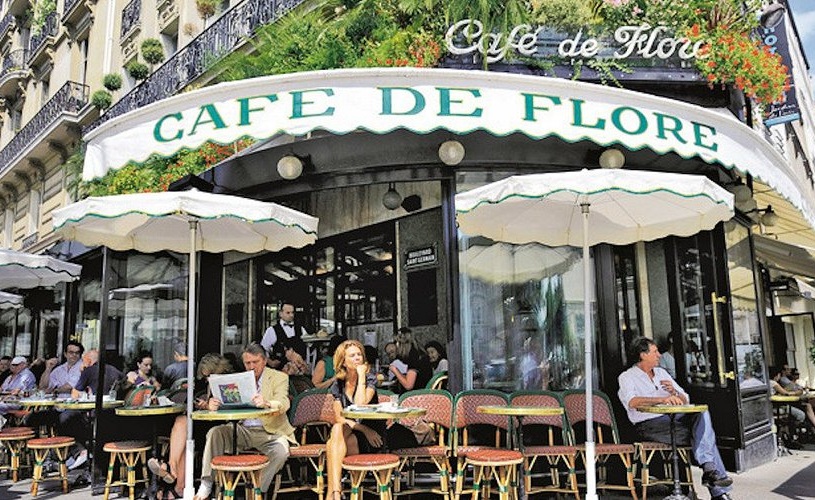
To fully grasp the enduring aura of Saint-Germain-des-Prés, stand across the boulevard near the terrace of Les Deux Magots or Café de Flore. From this vantage point, gaze across the cobblestone square toward the ancient bell tower. Throughout the Roaring Twenties and the postwar existentialist era, literary figures including Ernest Hemingway, Simone de Beauvoir, and Jean-Paul Sartre spent their days arguing philosophy and drinking coffee under this exact church's shadow. The towering Romanesque masonry served as an unchanging, stoic backdrop to their bohemian debates and nocturnal revellings. After taking in the contrast between bustling contemporary cafe society and early medieval stone, walk into the small churchyard garden flanking the southern facade. Here, secluded green spaces, fragments of ancient monastic masonry, and a bronze bust dedicated to poet Guillaume Apollinaire offer a tranquil sanctuary, letting you hear the church bells ring just as they have for over a millennium.

Paris Smart Guide

Ready to Explore Paris?

Download the Paris Smart Guide now and transform your travel experience

✨ Explore All App Features

Frequently Asked Questions

Why is the church called Saint-Germain-des-Prés?

The suffix des Prés means in the meadows, reflecting its 6th-century origin when the monastery was erected in open agricultural fields far beyond Paris's Roman city walls.

Is the Abbey of Saint-Germain-des-Prés the oldest church in Paris?

Yes, originally founded in 558 AD, its surviving Romanesque bell tower and elements of the nave make it the oldest standing church structure in the city.

What famous historical figures are associated with the abbey?

Merovingian kings were buried here, 17th-century philosopher René Descartes has his tomb inside, and modern literary figures like Hemingway and Sartre wrote under its shadow.

Do visitors need tickets to enter the Abbey of Saint-Germain-des-Prés?

Admission to the abbey church is free for individual travelers during regular daily opening hours, though visitors should remain quiet and respectful during scheduled religious services.

🏛️ Latin Quarter & Saint-Germain - More Points of Interest Nearby

Paris Smart Guide
★★★★★ 4.8 • FREE APP • OFFLINE GPS
Hear Paris's Hidden Stories
Your Personal Audio Guide • 10 Languages
🎧 Download the Free Walking Tour