










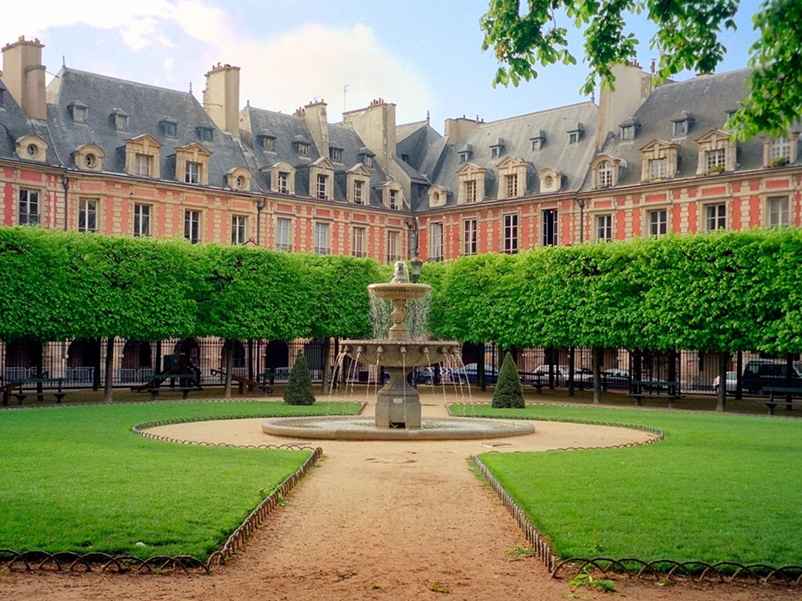
Why This Place Matters & Historical Backdrop
Le Marais stands out as an exceptional architectural survivor within Paris. When Baron Haussmann completely redesigned the capital in the nineteenth century, carving broad avenues through dense neighborhoods, Le Marais remained remarkably untouched. As a result, the area retains its original labyrinth of narrow medieval roadways alongside lavish seventeenth-century townhouses known as hôtels particuliers. Originally a marshland drainage project, the neighborhood transformed into a center of French nobility following the construction of the Place des Vosges under King Henri IV. Aristocrats commissioned magnificent private residences featuring high stone gates, carriage courtyards, and secluded formal gardens. Over subsequent centuries, the district evolved through multiple identities, serving as an artisan manufacturing hub, the cultural epicenter of Parisian Jewish life along Rue des Rosiers, and a modern hub for contemporary art and fashion. Exploring these cobblestone lanes allows visitors to touch surviving fortress walls, examine authentic medieval half-timbered framing, and understand the dramatic shifts of Parisian social hierarchy.