Uncover 800 Years of Rebellion & Genius in Paris's Latin Quarter
Step into the vibrant heart of Paris, the Latin Quarter, where 800 years of intellectual fervor echo through cobblestone streets. This historic student quarter, named for the Latin once spoken universally here, witnessed countless riots, shaped philosophical thought, and cradled literary giants. Prepare to journey through its iconic landmarks, from majestic mausoleums to hidden medieval alleys, revealing the profound stories that define Paris's Left Bank.
🎧 20-Second Audio Guide Preview
“Welcome to the Latin Quarter, Paris's 800-year-old intellectual heart. Stand before the monumental Panthéon; imagine it transforming from church to heroes' mausoleum. Look closely at Saint-Étienne-du-Mont, holding Paris's protector, and its unique rood screen. Notice the grand chapel of the Sorbonne. What radical ideas sparked here, shaping France itself?”
🗺️ Interactive Walking Route Map
Tap any numbered stop pin to preview its location & walking directions
The Crucible of European Thought: Sorbonne & Collège de France
The Latin Quarter has long been synonymous with intellectual pursuit, anchored by institutions like the Sorbonne and the Collège de France. Founded in 1257 by Robert de Sorbon, the Sorbonne began as a modest theological college for impoverished students. Yet, it quickly ascended to become the epicenter of European scholasticism, its theologians wielding such immense influence during the Middle Ages that they could effectively dictate law to the French King. Just steps away, King Francis I established the Collège de France in 1530, a direct counterpoint to the Sorbonne's conservative doctrines. This revolutionary institution offered free, open education in groundbreaking subjects like Hebrew, Ancient Greek, and Mathematics, a tradition of accessibility that remarkably continues to this day. Together, these two intellectual giants forged a dynamic environment that challenged and advanced knowledge.
From Royal Churches to Roman Ruins: Panthéon & Cluny
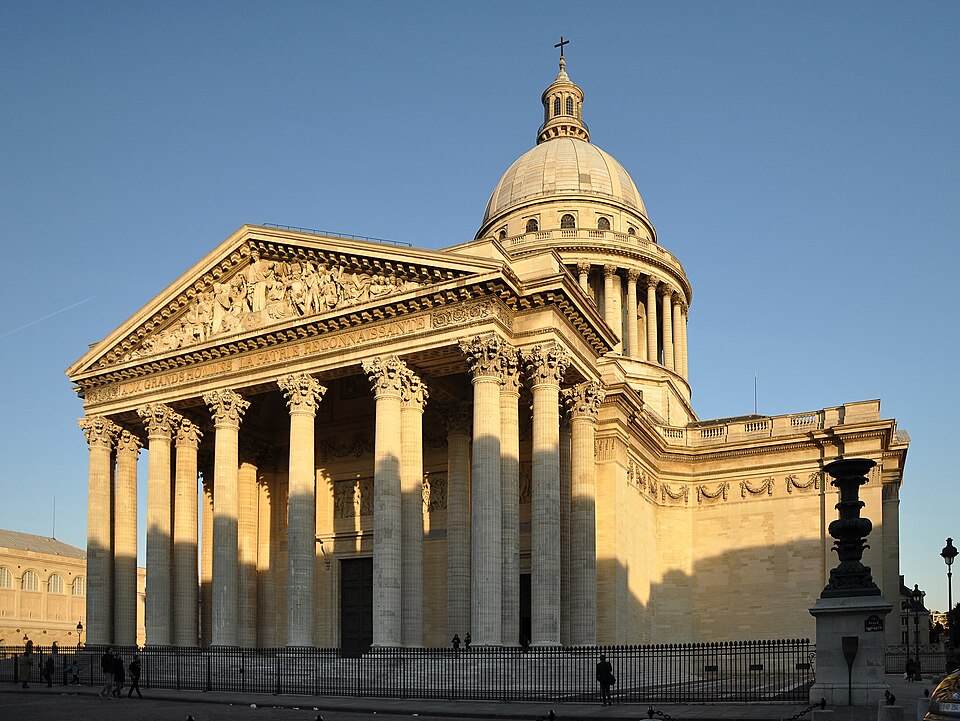
The Latin Quarter's landscape tells tales of dramatic shifts and enduring legacies. Commissioned by King Louis XV in 1758, the majestic Panthéon began as the Church of Sainte-Geneviève before the French Revolution transformed it into a secular mausoleum. Here, beneath its massive Neoclassical dome, France's greatest citizens, including Voltaire, Rousseau, Victor Hugo, and Marie Curie, now rest. Adjacent stands Saint-Étienne-du-Mont, a masterpiece built between the 15th and 17th centuries, which uniquely houses the relics of Sainte-Geneviève, Paris’s revered patron saint. Inside, visitors marvel at the city's only surviving Renaissance rood screen. Further south, the Hôtel de Cluny, a stunning 15th-century flamboyant Gothic mansion built for wealthy abbots, now presides over the National Museum of the Middle Ages, uniquely situated atop ancient 3rd-century Roman baths.
Student Revolutions, Medieval Alleys, and Literary Sanctuaries
Even Haussmann’s grand urban planning couldn't quell the spirit of rebellion in the Latin Quarter. Boulevard Saint-Michel, or 'Boul Mich,' was intentionally designed wide in the 1850s to prevent the barricades common in earlier uprisings. Yet, in May 1968, it became the flashpoint for a massive anti-capitalist student revolution, where millions famously tore up its cobblestones to hurl at police, paralyzing the government for weeks. A short walk reveals the stark contrast of Rue de la Huchette, a chaotic medieval maze untouched by such grand renovations. Once famed for taverns and roasted meats, it later became a hub for American jazz in the 1950s, and now bustles with Greek and Lebanese eateries. Finally, conclude at Shakespeare and Company, the legendary English bookstore opened in 1951, a haven where starving writers famously found refuge among its books.
Ready to Explore Paris?
Download the Paris Smart Guide now and transform your travel experience
Conclude at the legendary, tumbling English bookstore on the Seine that sheltered starving writers.
Frequently Asked Questions
Why is it called the Latin Quarter?
The Latin Quarter earned its name because, for centuries during the Middle Ages, Latin was the primary language spoken by the university students and scholars who populated this historic Parisian district.
What famous figures are buried in the Panthéon?
The Panthéon serves as a secular mausoleum for many of France's most celebrated citizens. Notable figures interred in its crypt include Voltaire, Jean-Jacques Rousseau, Victor Hugo, and Marie Curie.
What makes Saint-Étienne-du-Mont unique?
Located next to the Panthéon, the Church of Saint-Étienne-du-Mont is unique for housing the relics of Sainte-Geneviève, Paris's patron saint, and for possessing the city's only remaining Renaissance rood screen (jubé), an intricately carved partition separating the nave from the choir.
Can I still experience medieval Paris in the Latin Quarter?
Absolutely. While modernized, areas like Rue de la Huchette retain their narrow, chaotic medieval street layouts, untouched by Haussmann's 19th-century renovations, offering a glimpse into the district's ancient past.