Shadows of the Revolution: Unveiling Versailles' Private Trianon Estates
Step back in time to the opulent, yet controversial, Trianon Estates at the Palace of Versailles. Beyond the gilded halls of the main palace, discover a world where French monarchs sought refuge from rigid court etiquette, only to ignite the very revolution that would change history forever. Our audio guide will lead you through secret gardens and scandalous hideaways.
🎧 20-Second Audio Guide Preview
“Stand before the Grand Trianon. Look closely at the pink marble Peristyle, Louis XIV's private escape. Move towards the Petit Trianon, Marie Antoinette's sanctuary, where not even the King could enter without her invitation. Why did the Queen need such absolute privacy?”
The Grand Escape: Louis XIV's Sanctuary
Welcome to the Trianon Estates, where we'll uncover the private, controversial lives that sparked a revolution. Our journey begins at the Grand Trianon, a smaller palace built by Louis XIV in 1687, designed by Jules Hardouin-Mansart, for a physical escape from the suffocating etiquette of the main palace. Notice the open-air colonnade of the Peristyle, where the Sun King hosted intimate dinners with his mistress and closest friends, far from prying eyes. Later, the Petit Trianon, originally built by Louis XV in 1768 for Madame de Pompadour, was gifted to Marie Antoinette by Louis XVI. She famously established a rule: no one, not even the King, could enter without her explicit invitation, ensuring her absolute privacy.
Architectural Shifts and Royal Controversies
Our route continues to the French Pavilion, a masterpiece by Ange-Jacques Gabriel from 1750. This structure marks a fascinating architectural transition, sitting between the formal, geometric French gardens and the new, asymmetrical 'English-style' gardens championed by Marie Antoinette, reflecting an 18th-century philosophical shift towards romanticizing untamed nature. Nearby, the Queen's Theater, built by Richard Mique in 1780, is a perfectly preserved, hidden gem where Marie Antoinette controversially acted in stage plays herself. For a Queen to perform like a common actress deeply scandalized the French aristocracy and fueled negative rumors. Further on, the Temple of Love, also by Richard Mique in 1778, sits on a secluded island, becoming a focal point for malicious pamphlet propaganda claiming extravagant, secret midnight rendezvous.
The Hamlet's Fatal Flaws and Revolutionary Echoes
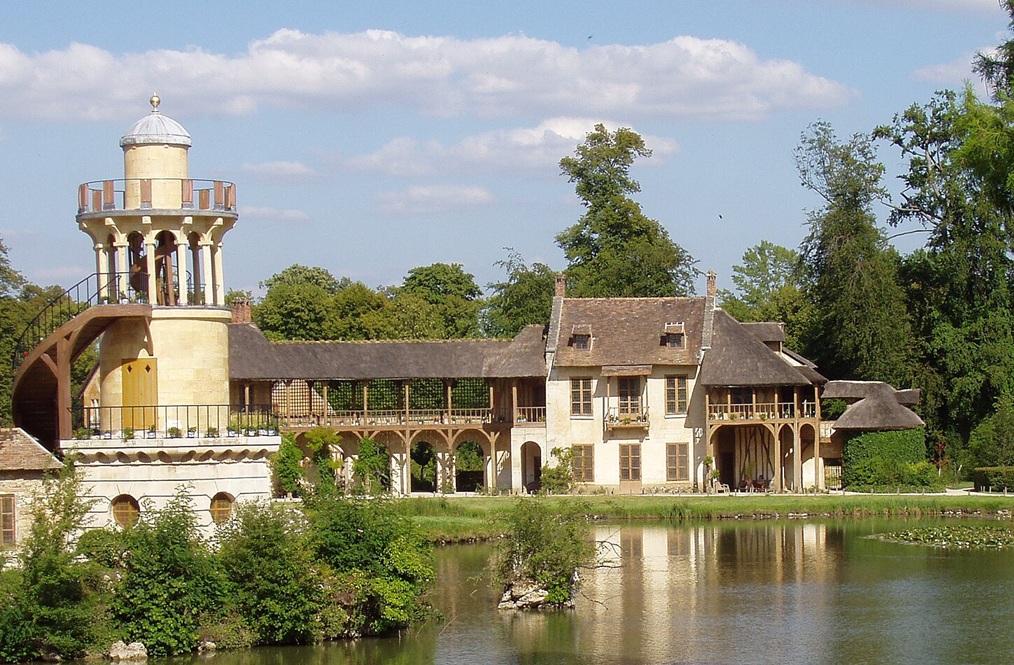
Next, we reach the Queen's Hamlet (Le Hameau), built by Richard Mique between 1783-1786. This fake peasant town, complete with working farms and thatched roofs, saw Marie Antoinette and her ladies dressing as shepherdesses to play 'milkmaid,' deeply insulating themselves from the horrific poverty and starvation plaguing real French peasants. The Marlborough Tower, a decorative dairy and fishery within the Hamlet, deliberately featured fake cracks and faux-decay on its exterior to appear 'poor,' while its interiors boasted fine Sèvres porcelain and royal luxury. Standing near the Mill, it's clear how the French public, suffering extreme bread shortages, viewed this expensive, fake village. Underground pamphlets exaggerated her spending, cementing her reputation as 'Madame Deficit' and making her the ultimate target of the Revolution. Our journey ends at the Cobblestone Courtyard, where on October 5-6, 1789, thousands of starving market women breached the gates, forcing Louis XVI and Marie Antoinette to leave the palace forever.
Ready to Explore Paris?
Download the Paris Smart Guide now and transform your travel experience
Follow these stops in the Paris Smart Guide mobile app with offline GPS & interactive AI.
1
The Grand Trianon (Entrance)
📍 Trianon Estate, Main Entrance.
Welcome to the private escape from the rigid court.
2
The Peristyle of the Grand Trianon
📍 Grand Trianon, Central Colonnade.
Louis XIV's pink marble sanctuary. The open-air colonnade where the King escaped the suffocating etiquette of the main palace.
3
The Petit Trianon
📍 Petit Trianon Estate.
The Neoclassical masterpiece built by Louis XV for his mistress, which later became Marie Antoinette's absolute private sanctuary.
4
The French Pavilion
📍 Petit Trianon Gardens.
The architectural transition from the strict geometric gardens of the King to the wild, romantic "English-style" gardens preferred by the Queen.
5
The Queen's Theater
📍 Petit Trianon Gardens (exterior view).
The perfectly preserved, hidden wooden theater where Marie Antoinette controversially acted in stage plays, scandalizing the French public.
6
The Temple of Love
📍 Petit Trianon, English Gardens.
A stunning Neoclassical gazebo visible from the Queen's bedroom window, surrounded by rumors of extravagant, secret midnight rendezvous.
7
The Queen's Hamlet (Le Hameau)
📍 The Hamlet.
The faux-rustic Norman village. Why the Queen of France built a fake peasant town to play "milkmaid" while the real country starved.
8
The Marlborough Tower
📍 The Hamlet, Lakeside.
The decorative dairy and fishery. How the royal architects romanticized extreme poverty into a billionaire’s playground.
9
The Mill and the Farm
📍 The Hamlet.
Analyzing the devastating PR disaster of the Hamlet and how "pamphlet propaganda" used this village to destroy the Queen's reputation.
10
The Cobblestone Courtyard
📍 Main Palace Courtyard (Cour de Marbre).
October 1789. Standing where the angry mob of Parisian women marched on Versailles, forcing the royal family to leave the palace forever.
Frequently Asked Questions
What is the significance of the Grand Trianon at Versailles?
It was Louis XIV's private escape from court etiquette, designed by Jules Hardouin-Mansart in 1687, where he hosted intimate gatherings away from prying eyes and the suffocating formality of the main palace.
Why was Marie Antoinette's Queen's Hamlet so controversial?
Built between 1783-1786, this faux-rustic village where she played 'milkmaid' deeply insulated her from real peasant poverty. It became a potent symbol of royal excess and indifference, fueling revolutionary propaganda as the French public suffered from extreme bread shortages.
Can I visit the Queen's Theater at the Trianon Estates?
Yes, the Queen's Theater, built by Richard Mique in 1780, is a remarkably preserved hidden gem. It's famous for being where Marie Antoinette controversially acted herself, an act that deeply scandalized the French aristocracy and fueled negative rumors about her character.
How does this audio guide enhance my visit to the Trianon?
Our audio guide illuminates the historical context and scandalous stories behind each stop, from Louis XV's Petit Trianon to the precise location of the Women's March. It offers a deeper, more immersive understanding of the private lives that inadvertently sparked a revolution, ensuring you don't miss any critical details.