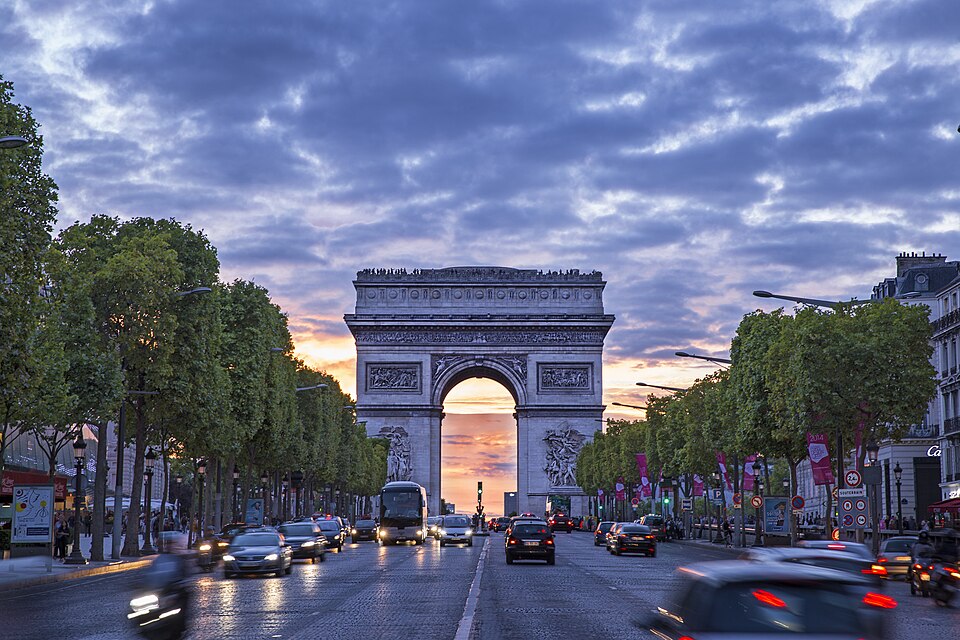
Walk the Triumphal Way: Napoleon's Grand Vision & Haussmann's Paris
Step onto the legendary Champs-Élysées, where centuries of Parisian history unfold beneath your feet. Discover how Emperor Napoleon III and Baron Haussmann drastically reshaped medieval Paris into the majestic metropolis you see today. This self-guided audio tour reveals the dramatic story behind iconic landmarks from the Place de la Concorde to the Arc de Triomphe.
🎧 20-Second Audio Guide Preview
“Stand at Place de la Concorde. Look closely at the ancient Luxor Obelisk, a neutral marker amidst revolutionary history. Notice the majestic Marly Horses, guardians of the Champs-Élysées. Walk this historic path, once a royal garden, now a symbol of Parisian grandeur. What stories echo here?”
🗺️ Interactive Walking Route Map
Tap any numbered stop pin to preview its location & walking directions
The Birth of a Grand Avenue: Royal Gardens to Imperial Vision
From the vision of Napoleon III and Baron Haussmann, medieval Paris began its dramatic transformation into a modern metropolis. Our journey starts at the Place de la Concorde, home to the ancient Luxor Obelisk. Gifted by Egypt in 1833, this 3,300-year-old monument was strategically placed as a politically neutral symbol where the guillotine once stood, ending decades of political strife over the square's identity. Further up, the monumental Marly Horses, 1740s replicas (originals in the Louvre), act as grand gatekeepers, marking the precise beginning of the two-kilometer Champs-Élysées. This iconic avenue, whose name means "Elysian Fields," began its life modestly in 1667 as a tree-lined garden path, meticulously designed by King's gardener André Le Nôtre to extend the royal view from the Tuileries Palace into the countryside.
Haussmann's Radical Renovation & High Culture
The mid-19th century brought an unprecedented urban upheaval under Napoleon III and Baron Haussmann. From 1853 to 1870, Haussmann systematically demolished vast swathes of medieval Paris. His objective was clear: eradicate disease, alleviate traffic congestion, and prevent riots in narrow alleys. The result was a city reborn with massive, straight boulevards, uniformly lined with cream-colored stone apartment buildings, complete with intricate iron balconies. This radical urban planning literally invented the iconic, elegant face of Paris seen today. As the avenue gained popularity, especially under Napoleon III, its lower gardens became a hub for high culture, with elegant theaters like the Théâtre Marigny (built 1883) hosting operettas and solidifying the area's reputation for elite entertainment and sophisticated leisure among the Parisian bourgeoisie.
Global Luxury & Napoleon's Enduring Legacy
The Champs-Élysées evolved significantly in the 20th century. What began as aristocratic mansions transformed into a globally renowned commercial shopping street. The advent of the Paris Métro and widespread electricity fueled this transition, cementing the upper avenue's status as an international symbol of extreme wealth and tourism. A pivotal landmark, Fouquet's Brasserie, established in 1899, became the legendary epicenter of the French film industry, a celebrated haunt for actors and directors, and still hosts the post-César Awards gala. Our journey culminates at the magnificent Arc de Triomphe, commissioned in 1806 by Napoleon I to commemorate his victory at Austerlitz. He promised his soldiers a triumphant return, though he died before its completion. Beneath this grand arch lies the Tomb of the Unknown Soldier from World War I, added in 1921. Its eternal flame, rekindled nightly at 6:30 PM, transforms the arch from a monument of imperial conquest into a sacred site of national mourning and peace.
Ready to Explore Paris?
Download the Paris Smart Guide now and transform your travel experience
Conclude at the solemn, eternal flame of remembrance that changed the arch into a sacred site of mourning.
Frequently Asked Questions
What historical period does this audio tour primarily cover?
This audio tour primarily covers the mid-19th century transformation of Paris under Emperor Napoleon III and Baron Haussmann, alongside earlier origins and later developments leading to the 20th century.
What is the significance of the Luxor Obelisk in Place de la Concorde?
The Luxor Obelisk, gifted to France in 1833, was chosen for Place de la Concorde as a politically neutral monument, deliberately placed where the guillotine once stood to end ongoing political disputes over the square's identity.
How long is the walk from the Luxor Obelisk to the Arc de Triomphe?
The Champs-Élysées stretches approximately two kilometers from the Marly Horses, near Place de la Concorde and the Luxor Obelisk, up to the Arc de Triomphe. The audio guide segments the walk into manageable stops.
Can I use this audio tour offline?
Yes, once downloaded, this audio tour is fully accessible offline on your mobile device, allowing for seamless exploration of the Champs-Élysées and Arc de Triomphe without needing an internet connection.