Walk the Golden Path: Paris's Belle Époque & The Triumphal Way Revealed
Step back in time to Paris's Belle Époque, an era of unparalleled artistic and technological triumph. This spectacular path was meticulously crafted for the 1900 World's Fair, designed to assert France as the undisputed cultural capital of the world. From the gleaming Grand Palais to the ornate Pont Alexandre III, prepare to witness a testament to golden ambition and architectural marvels.
🎧 20-Second Audio Guide Preview
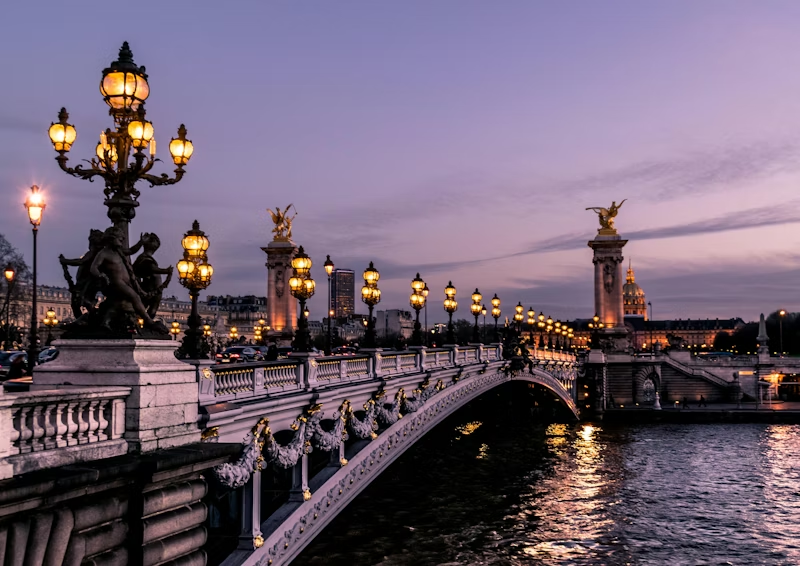
“Look closely at the gilded bronze Nymphs restraining Pegasus, symbolizing Art, Science, Commerce, and Industry. Stand on Pont Alexandre III, named for Tsar Alexander III, a diplomatic marvel from the 1900 World's Fair. Notice its single, ultra-flat steel arch. Why was this engineering feat so crucial?”
🗺️ Interactive Walking Route Map
Tap any numbered stop pin to preview its location & walking directions
The year 1900 marked a pivotal moment for Paris, as the city hosted a World's Fair designed to unequivocally prove France's standing as the global cultural capital. This ambition is palpable along the Triumphal Way, a route meticulously crafted for the event. Pont Alexandre III, a breathtaking masterpiece of Belle Époque excess, embodies this spirit. Named after Tsar Alexander III of Russia, it celebrated a crucial Franco-Russian alliance, adorned with gilded statues, cherubs, and Art Nouveau lamps. Look closer at the massive gilded bronze Fames, restraining Pegasus horses atop the bridge's pillars; these 17-meter-high figures proudly represent the triumphs of Art, Science, Commerce, and Industry, setting a grand stage for the era's achievements.
Architectural Wonders: Steel, Stone, and Iconic Domes
Beyond sheer aesthetics, the Belle Époque's structures often concealed incredible engineering feats. The Pont Alexandre III, while visually opulent, stands on a remarkable single 6-meter-high steel arch, purposefully designed to be exceptionally flat. This innovation ensured an uninterrupted monumental perspective, preserving the view of the majestic Les Invalides Dome. Begun in 1670 under Louis XIV as a hospital, this golden dome now serves as Emperor Napoleon Bonaparte’s colossal tomb, a testament to enduring power. Directly connecting this view, the Grand Palais, built for the 1900 Fair, boasts Europe's largest glass barrel-vaulted roof with 8,500 tons of steel cleverly hidden behind a classical stone façade, mirroring the industrial revolution's blend with Beaux-Arts elegance. Its counterpart, the Petit Palais, designed by Charles Girault, completes this architectural ensemble across the avenue.
From Royal Gardens to Haussmann's Grand Vision
Our journey concludes tracing the urban evolution from royal domains to Baron Haussmann’s modern Paris. Avenue Winston Churchill, originally Avenue Nicolas II, was an intentional urban intervention, carved into the city to establish an uninterrupted monumental axis connecting the new palaces directly to Les Invalides. This grand perspective then transitions into the tranquil Champs-Élysées Gardens. Developed under Napoleon III, these lush, English-style landscaped areas offered shaded promenades, puppet theatres, and refined outdoor cafes for the Parisian elite, a stark contrast to the formal stone squares. Finally, we reach Place de la Concorde, Paris’s largest square, a site of immense historical significance. Originally Place Louis XV, it bore witness to the guillotine executions of King Louis XVI and Marie Antoinette, later renamed "Concorde" in 1795 to foster national healing, acting as the geographic hinge linking the Louvre to the Champs-Élysées.
Ready to Explore Paris?
Download the Paris Smart Guide now and transform your travel experience
Conclude in the largest square in Paris, marking the transition from royal gardens to Haussmann's modern city.
Frequently Asked Questions
What is the Belle Époque in Paris?
The Belle Époque ("Beautiful Era") was a period of peace, prosperity, and cultural flourishing in France, particularly Paris, from the late 19th century until World War I. The 1900 World's Fair epitomized this era's ambition and artistic achievements.
What is the significance of Pont Alexandre III?
Pont Alexandre III was built for the 1900 World's Fair, named after Tsar Alexander III of Russia to commemorate the Franco-Russian alliance. It's renowned for its opulent Belle Époque design and its engineering marvel of an ultra-flat steel arch.
What can I see at Les Invalides Dome?
Les Invalides was originally a military hospital built by Louis XIV. Its magnificent golden dome now serves as the grandiose tomb of Emperor Napoleon Bonaparte, a significant historical site.
How does this audio guide enhance my visit to the Triumphal Way?
Our audio guide transforms your walk into an immersive historical journey, revealing hidden details and stories behind iconic sites like the Grand Palais, Petit Palais, and Pont Alexandre III. It highlights engineering feats, diplomatic messages, and artistic symbolism, making history come alive right where you stand.